By Sharon Kyatusiimire
July 20th, 2026
KAMPALA – Uganda has been urged to treat its natural resources as economic assets and integrate their protection into national planning and investment decisions to strengthen climate resilience and ensure sustainable economic growth.
The call was made by the Minister of State for Environment, Hon. Beatrice Anywar, during the launch and dissemination of five policy briefs on Uganda's Natural Capital Accounts under the theme, "Advancing Climate-Informed Economic Policy and Sustainable Development in Africa." She represented the Minister of Water and Environment, Gen. Kahinda Otafiire.
Speaking at the event, Hon. Anywar said Uganda's forests, wetlands, water bodies and other ecosystems should no longer be viewed merely as environmental resources but as critical economic assets that support livelihoods, economic stability and national development.
She observed that previous generations placed greater value on protecting nature because they understood the direct link between healthy ecosystems and their livelihoods. However, changing lifestyles, rapid population growth and increasing environmental degradation now demand stronger policies and renewed commitment from both government and citizens.
"The next time you approve a project, allocate a budget for natural capital protection," Hon. Anywar said, urging government agencies to ensure environmental conservation is incorporated into development planning and public investments.
She also called for wider adoption of nature-based solutions and cleaner energy alternatives, noting that reducing dependence on firewood would not only conserve forests but also improve household welfare.
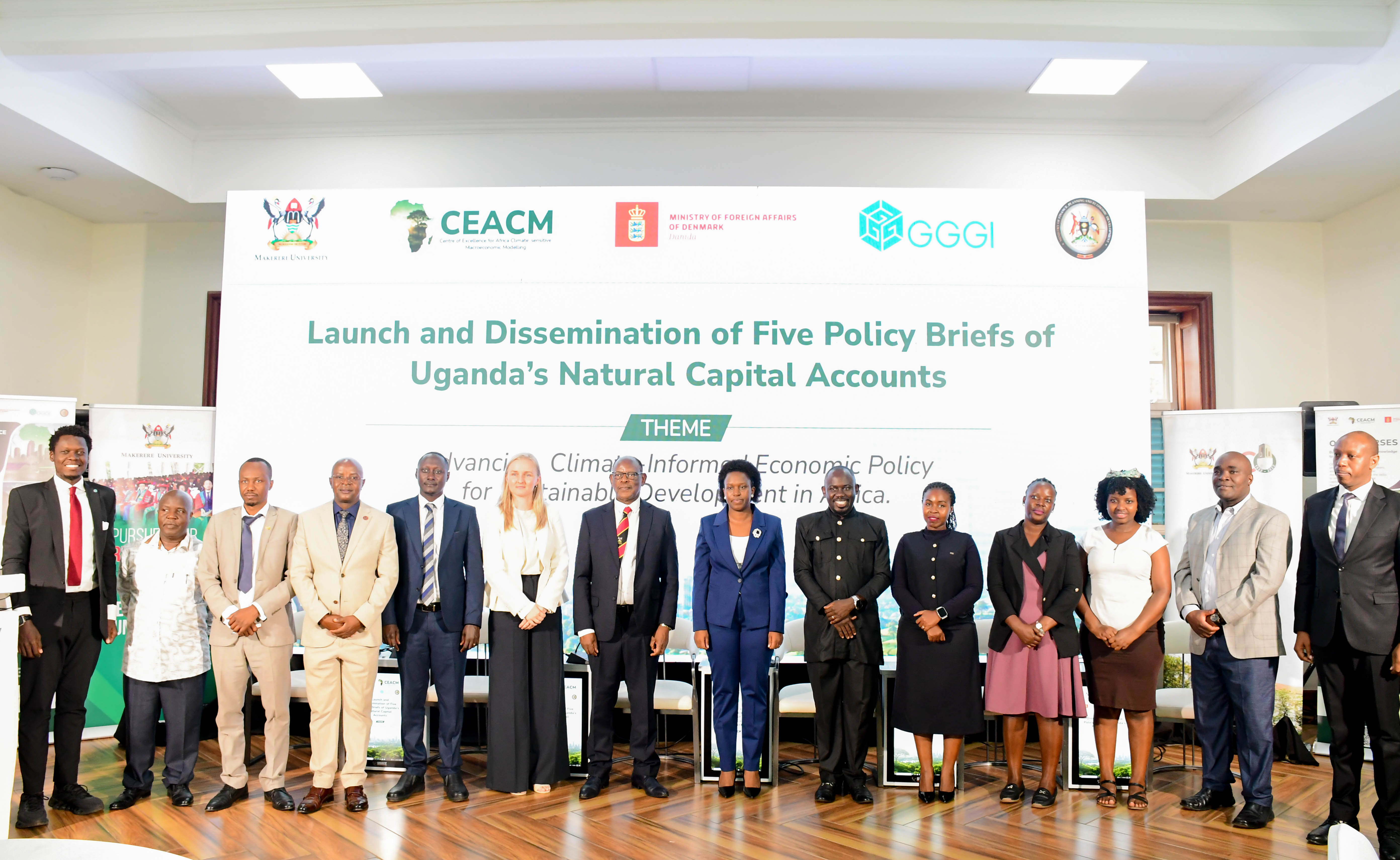
The five policy briefs were developed by the Centre of Excellence for Africa Climate-Sensitive Macroeconomic Modelling (CEACM) at Makerere University's College of Business and Management Sciences (CoBAMS), with support from the Gates Foundation, the Global Green Growth Institute (GGGI) and the Embassy of Denmark. The briefs provide evidence to guide government decision-making on the economic value of forests, wetlands, water resources, biodiversity and other natural assets.
Officially opening the event, Makerere University Vice Chancellor Prof. Barnabas Nawangwe reaffirmed the university's commitment to supporting government through research that informs sustainable development policies.
"We thank all our partners and funders for recognising Makerere University as a trusted partner in advancing climate-informed policymaking. We look forward to strengthening these partnerships. We have the infrastructure and human resource capacity to contribute meaningfully to Uganda's and Africa's economic development agenda," Prof. Nawangwe said.
Representing the Ministry of Finance, Planning and Economic Development, Prof. Davis Vimegomba, Acting Commissioner for Macroeconomic Development, said addressing climate change requires stronger collaboration between researchers, policymakers and development partners.
"Bridging the gap between climate science and policy is not merely a technical task, it is a governance challenge that requires structured collaboration between researchers and decision-makers," he said.
He added that Makerere University's partnership with the Ministry of Finance demonstrates how academia can strengthen evidence-based economic management.
"Makerere's collaboration with the Ministry of Finance, Planning and Economic Development stands as a shining example of how academia and government can strengthen economic management," he said.
Prof. Edward Bbaale, Director of CEACM, said the Centre is focused on building African expertise to enable governments to integrate climate and natural capital considerations into fiscal and macroeconomic policy.
"Our goal is to ensure African Ministries of Finance have home-grown expertise to integrate climate and natural capital considerations into fiscal and macroeconomic policy. This is critical for long-term resilience and sustainable development," Prof. Bbaale said.
He noted that although climate change continues to have far-reaching impacts across sectors, Africa is well positioned to develop solutions that respond to its own realities.
"Climate change has deep, cascading effects across sectors, but Africa has enormous potential to lead climate solutions," he said.
Climate Finance, Global Green Growth Institute (GGGI) Representative, Arthur Ssebbugga-Kimeze who represented the Country Director said the launch of new policy briefs coincides with Uganda’s ongoing update of natural capital accounts led by UBOS, in collaboration with the Ministry of Finance and supported through the Denmark-GGGI partnership.
The policy briefs are expected to help policymakers better understand the contribution of natural resources to Uganda's economy and promote the integration of environmental considerations into national development planning.
The five policy briefs launched are: Uganda's Wood Stock on a Declining Pathway to Extinction: A Call for Review and Action, Uganda's Energy System at a Crossroads: The Unsustainable Reliance on Biomass and the Need for Energy Transition, Integrating Natural Capital into Development Planning in Uganda: Insights from Ecosystem Services and Asset Accounts (1990–2025), Leveraging Land Natural Capital to Drive Uganda's Sustainable and Inclusive Growth and National Accounts Development: Tracking Uganda's Progress Amid Climate Change

Sharon Kyatusiimire
Co-Founder & Executive Director, She-Voice Uganda. Gender Responsive Reporting and Communication Trainer, Journalist, Public Relations specialist, Content Developer, Women Empowerment Activist.